7 Stunning Bichon Frise Grooming Styles: A Professional Guide to the Perfect Powder Puff Look
Thank you for reading this post, don't forget to subscribe!The Bichon Frise Grooming Styles you choose define significantly more than just your dog’s immediate appearance; they represent a beautiful legacy of canine elegance. Originally known as the “Barbichon” due to their striking resemblance to the Barbet, these resilient little aristocrats were historical favorites in the French courts. After decades of standing behind the table at Pooches Hair Studio, I can confidently tell you that the Bichon Frise is essentially a living, breathing sculpture. Their unique, dual-layered coat provides the absolute perfect canvas for a variety of highly technical cuts. Whether you are aggressively preparing for a prestigious dog show or simply seeking a highly manageable “Puppy Cut” for everyday home life, understanding the structural requirements of these specific Bichon Frise Grooming Styles is the vital first step. Ultimately, this knowledge ensures their long-term health and maintains their signature “powder puff” aesthetic.
Mastering the Bichon Frise Coat: Texture and Requirements
To flawlessly achieve the best Bichon Frise Grooming Styles, one must first deeply respect the inherent complexity of the coat itself. Unlike many other common breeds, the Bichon Frise does not shed in the traditional, seasonal sense. Instead, the hair continuously grows, tightly weaving itself into the existing curls. Consequently, this makes the breed incredibly prone to severe, painful matting if the texture is not handled with professional-grade expertise.
The Importance of the Dense Undercoat and Silky Outer Curls
The true secret to the “springy,” plush feel of a well-groomed Bichon is the delicate balance between the dense undercoat and the silky topcoat. Specifically, the undercoat acts as an internal support system, physically pushing the outer curls outward to create massive volume. When executing various Bichon Frise Grooming Styles at our salon, we must ensure the undercoat is thoroughly “blown out” using a professional high-velocity dryer. If the undercoat remains even slightly damp or clumped together, the final scissored style will immediately look flat and lose its iconic, bouncy roundness.
Identifying the Proper FCI Standard Texture for Professional Cuts
Professional stylists constantly look for a coat that strongly resembles “Mongolian goat” hair—long, remarkably silky, and very loosely curled. When we evaluate potential Bichon Frise Grooming Styles, we specifically look at how the hair naturally stands away from the dog’s body. A coat that lies limp or feels excessively “woolly” is very often a direct sign of improper drying techniques or a lack of essential mineral treatments. Therefore, to maintain this pristine texture, I highly recommend using premium, high-end products like iGroom or Hyponic. These are specifically formulated to meticulously maintain the cuticle’s integrity without heavily weighing down the fine, white strands.
The Iconic Show Cut: Achieving the “Standard” Bichon Frise Grooming Style
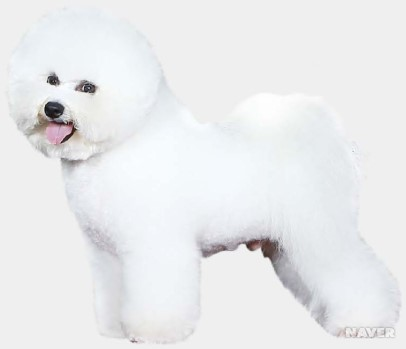
When enthusiastically discussing elite Bichon Frise Grooming Styles, the quintessential “Show Cut” undoubtedly stands high above the rest. This exacting, highly technical style adheres strictly to official breed standards, miraculously transforming the dog into a perfectly balanced, living cloud. Furthermore, it requires a true master groomer’s touch, heavily utilizing advanced hand-scissoring techniques rather than simple, quick clipper work.
Technical Scissoring: Creating the Bell-Shaped Head
The absolute defining hallmark of traditional Bichon Frise Grooming Styles is the flawlessly sculpted, rounded head. At Pooches Hair Studio, we rely on high-quality, razor-sharp curved shears to meticulously craft a slightly bell-like shape. Consequently, this shape must blend seamlessly into the neck without any harsh, visible lines. The pristine white hair around the ears, beard, and mustache must be scissored to form a continuous, incredibly soft circle. Ultimately, the dark, highly expressive eyes and the solid black nose should pop vividly against the facial canvas, creating a striking and mathematically perfect isosceles triangle.
Maintaining the Cylindrical Leg Appearance
To completely perfect this specific, high-end variation of Bichon Frise Grooming Styles, the dog’s legs must look like sturdy, unbroken, plush columns. We expertly achieve this by scissoring the leg hair straight down to the table. Therefore, ensuring the forelegs appear perfectly vertical and parallel from the front angle is absolutely essential. While the actual internal bone structure of the dog is quite moderate, the dense, fully blown-out coat is carefully sculpted to mask the underlying anatomy. Finally, the feet are scissored to look tightly rounded, often lovingly referred to in the industry as “cat feet.”
The Secret to the Undipped Tail Plume
Unlike many other terriers or small companion breeds, the Bichon’s tail is purposely left relatively natural in show-standard Bichon Frise Grooming Styles. The tail is anatomically set slightly below the topline and curves gracefully over the back. However, it must never be tightly curled into a stiff ring. Furthermore, the long, incredibly feathery plume is strictly never clipped or aggressively thinned out. Instead, it is gently brushed out to cascade elegantly over the dog’s back, beautifully completing the sophisticated, balanced silhouette.
Popular Low-Maintenance Bichon Frise Grooming Styles
While the traditional show cut is undeniably breathtaking, it requires grueling, daily, intensive brushing to prevent the thick undercoat from clumping. Therefore, for most everyday pet owners, opting for low-maintenance Bichon Frise Grooming Styles is the most highly practical choice. Consequently, these adorable pet trims perfectly preserve the breed’s signature features while drastically reducing the stressful time spent on the grooming table.
The “Puppy Cut”: Practicality Meets Cuteness
The “Puppy Cut” is universally loved and is unquestionably the most requested style by busy families at our salon. In this specific variation of Bichon Frise Grooming Styles, the hair on the body, legs, and neck is evenly clipped to a uniform, manageable length, usually around 1 to 2 inches. Meanwhile, the head and ears are lightly hand-trimmed to maintain a very soft, puppy-like expression. Ultimately, this length is long enough to beautifully show off the breed’s signature curls but short enough to make your daily home brushing an absolute breeze.
The “Teddy Bear Cut”: Enhancing Facial Roundness
If you genuinely want to maximize the “aww” factor, the “Teddy Bear Cut” is an exceptional, highly stylized choice. This beautiful style flawlessly blends the practicality of a short body with the highly stylized look of a massively rounded face. The torso and upper legs are clipped relatively short, while the lower legs are left slightly fuller to effectively create a “boot” effect. Then, I use my specialized curved shears to sculpt the head and muzzle into a perfect, plush, seamless circle. Consequently, this specific technique brilliantly highlights their dark, round eyes, giving them the undeniable appearance of a literal stuffed animal.
Summer Shave-Downs: When and How to Safely Clip
Sometimes, a complete “shave-down” becomes absolutely necessary, either due to severe, impenetrable matting or a highly active outdoor lifestyle during scorching summer months. However, when safely executing extremely short Bichon Frise Grooming Styles, dermatological safety is paramount. The Bichon’s underlying pink skin is highly susceptible to painful sunburn. Therefore, as a strict professional standard at Pooches Hair Studio, I never shave a Bichon completely down to the bare skin unless it is medically necessary. Instead, I always use a longer protective clipper guard, such as a #4 or #5 blade. This purposely leaves at least half an inch of soft coat to successfully protect the fragile epidermis from harmful UV rays.
Specialized Techniques for Professional Bichon Stylists
Executing truly flawless Bichon Frise Grooming Styles requires significantly more than just exceptional scissoring skills. Furthermore, it demands a deep, scientific understanding of canine dermatology and coat structure. The Bichon’s pristine, bright white coat is an absolute magnet for environmental dirt. In addition, their underlying pink skin is notoriously sensitive to harsh, cheap chemicals.
Using iGroom and Hyponic for Volume and Shine
The absolute baseline foundation of all elite Bichon Frise Grooming Styles is the proper chemical preparation of the hair shaft. In my salon, I strictly and exclusively utilize premium, volumizing products like iGroom and Hyponic. These highly concentrated, powerfully hypoallergenic formulas are brilliantly engineered to lift the heavy coat directly from the root. Consequently, they achieve this massive volume without stripping away any essential natural skin oils. Following the thorough rinse, applying a lightweight, leave-in conditioning spray perfectly helps close the hair cuticles. This vital step ensures the outer curls remain bouncy, brilliantly white, and highly resilient against summer humidity.
Skin-Medicated Baths: Treating the Sensitive Bichon Epidermis
Genetically, Bichons are heavily predisposed to various frustrating skin anomalies, including raw hot spots, environmental contact dermatitis, and severe yeast overgrowth. When a client presents a Bichon with highly inflamed or irritated skin, utilizing standard commercial grocery-store shampoos will only disastrously exacerbate the issue. Consequently, this will ultimately ruin the structural potential of any Bichon Frise Grooming Styles. In these critical, sensitive cases, I immediately pivot our salon protocol to targeted skin-medicated baths. The specialized medicated lather must be massaged deeply into the skin and allowed to sit for a full ten minutes to be truly therapeutically effective.
Real-World Case Study: Transforming a Matted Bichon at Pooches Hair Studio
One of the most emotionally challenging aspects of maintaining Bichon Frise Grooming Styles is dealing with neglected, severely tangled coats. Just last month, a frantic, tearful client brought in “Oliver,” a two-year-old Bichon. Unfortunately, Oliver’s dense undercoat had completely pelted together into a solid, impenetrable shell due to improper, surface-level home brushing. The owner was absolutely terrified we would have to shave him completely bald, losing his beautiful powder puff identity forever.
As a master groomer, my absolute first priority is always the dog’s physical comfort and safety. However, I also fiercely try to preserve the breed’s structural dignity whenever humanly possible. Instead of initiating an immediate surgical shave-down, I carefully assessed Oliver’s severe matting to see exactly what could be safely salvaged. I determined that with specialized lipid-based detangling solutions and extreme, painstaking patience, we could save enough of his damaged coat to successfully perform a modified Teddy Bear Cut.
We started with a heavy, soaking saturation of a professional iGroom dematting serum. Next, I gently worked through the less severe tangles using a flexible slicker brush and a steel greyhound comb. After a highly soothing, hydrating bath using a silk-protein conditioner to rapidly repair the highly stressed hair shafts, we began the intricate hand-scissoring process.
The physical transformation was absolutely incredible. While we had to take his body length significantly shorter than a traditional show cut, I meticulously sculpted his head to brilliantly highlight his expressive dark eyes and solid black nose. Oliver happily left Pooches Hair Studio looking plush, perfectly round, and most importantly, feeling entirely pain-free. Ultimately, this specific case perfectly illustrates exactly why regular, professional salon maintenance is absolutely non-negotiable.
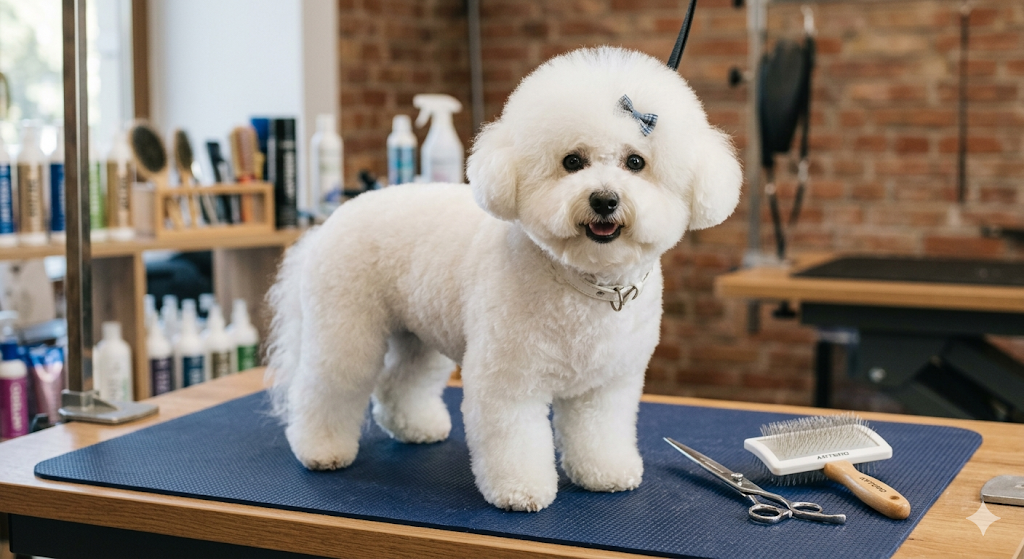
Bichon Frise Grooming Styles Comparison Table
Choosing the right look depends entirely on your daily lifestyle and your personal commitment to brushing. To quickly help you make the best decision for your dog’s long-term coat health, here is a professional salon breakdown:
| Grooming Style | Maintenance Level | Salon Frequency | Ideal Client Profile | Key Characteristics |
| Traditional Show Cut | Very High (Daily) | Every 3-4 Weeks | Show exhibitors | Sculpted bell-head, cylindrical legs, untouched tail. |
| Puppy Cut | Low to Medium | Every 6-8 Weeks | Busy families | Uniform 1-2 inch body length, soft natural face. |
| Teddy Bear Cut | Medium | Every 4-6 Weeks | Max “cuteness” seekers | Shorter body, fuller legs, perfectly rounded face. |
| Summer Shave-Down | Very Low | Every 8-10 Weeks | Matted dogs / Hot areas | Short body (#4 blade), short ears to prevent sunburn. |
FAQ: Pro Tips for Bichon Frise Maintenance
How often should I thoroughly brush my Bichon Frise at home? To properly maintain longer Bichon Frise Grooming Styles, you must meticulously brush your dog daily. Always use a high-quality slicker brush and a steel greyhound comb to confidently part the hair completely down to the skin (known as line brushing).
How do I safely prevent red tear stains on my Bichon’s white face? Tear staining is a frustrating, common issue that can instantly ruin the crisp look of professional Bichon Frise Grooming Styles. Keep the hair around the eyes trimmed very short, carefully wipe the area daily with a pet-safe saline solution, and strictly ensure your dog drinks filtered water.
What are the absolute best tools for maintaining a Bichon coat? A professional-grade setup is crucially vital for home maintenance. I highly recommend investing in a premium slicker brush, a fine-toothed stainless steel greyhound comb, and a high-quality detangling spray. Never aggressively brush a dry coat without misting it first to prevent breaking the delicate ends.
https://www.poocheshairstudio.com
Find more expert grooming tips at our [Poochestips Home]
Pooches Hair Studio Official Website: [poocheshairstudio]
"Healthy paws, happy dogs. Visit [Poochestips Home] for more comprehensive guides!"
Discover our top grooming product recommendations at [Pooches Choice]!
(As an Amazon Associate, I earn from qualifying purchases. This helps support our blog in providing valuable information for dog owners at no extra cost to you.)